Kirsle.net
For now you can download it, or browse the source code and Javadocs, at /projects/Java/.
I started with Sun's tutorials, beginning with basic command-line apps to get the syntax down, then moving into the GUI tutorials with Swing. I'm not putting high priority on learning Java applet programming right at the moment, because nobody likes Java applets anymore.
And so now I'm at the point where I'm attempting to program my own things from scratch. A logical place to start was to create a Java class for the CyanChat protocol. The goal of it is to match the functionality of Net::CyanChat, and then one day I might even program a "Java CyanChat Client", to complement my current Perl CyanChat Client (and by Java CC Client, I don't mean an applet; the standard CyanChat client is an applet -- I mean a GUI application).
My CyanChat package is named org.kirsle.network.CyanChat for right now. Eventually I intend to program a RiveScript interpreter in Java, to open the door up to Java developers to get into the world of RiveScript (and because the only RiveScript interpreter currently in existence is written in Perl). Then, one of my goals in C++ is to compile a "RiveScript.dll" file, which can be dynamically linked with C/C++ programs or any other language that can dynamically link a DLL. :)
Since I'm serious about Java development, I made a nice lil avatar for Java-related blog posts, and spent more than 5 minutes creating it too.
Maybe they just want the links to be there for Google to see... to improve the page rank of their scam site so that it comes up higher in Google search results. They just want links from the forums they spam, not necessarily clicks.
Thus an interesting idea for web forum software: add a kind of restriction on link posting. Like how some forums require that you post 10 things that aren't spam before you're allowed to send private messages to other users, or other such arbitrary restrictions... what would be useful is one that goes: you can post links immediately after signing up, but every link you post will have rel="nofollow" attached to it, so that Google and other search spiders won't follow your link, and you won't get Pagerank credit for it. And then after posting enough on the forum, all your previous links and all future links will be linkable for search engines then.
Spam bots always seem to find ways to register and spam forums, but taking away their ability to get any Pagerank credit for their spamming would help fight back just a little bit.
/random thought of the day/
Right now, my page doesn't validate as HTML 4.01 Strict, because <script> tags aren't allowed to have a id attribute. What script tag has the ID attribute? The one to display the countdown until Fedora 10's release. If I remove the ID attribute, the script breaks. Nonetheless I'm going to keep it there only for the next three days until Fedora 10 finally arrives, then it's history and next time I want to count down until Fedora 11, I'll find my own implementation instead of pasting their awful HTML code into my otherwise perfect pages.
I've ranted about pasting external code into my site before, so I'll spare you any continued rambling for now. Sometime when I'm more motivated I might follow up on this rant with a sequel.
The moral of the story is, don't give me any code to paste anywhere in anything I have unless the code is completely valid and passes all validation tests (for HTML, that means it passes HTML 4.01 Strict standards).
Speaking of which, I wanted to say a little something about web development. Why have a degree in web design?, some people ask. Any 12-year-old can open Notepad and create a web page. I agree -- and I was that 12-year-old at one point in my life. What separates the men from the boys is the ability to create a web page that validates against the W3C's strictest standards. Yeah, any little kid can throw together a mess of HTML tags and get something out of it. They might even be lucky enough that their page works on every browser. But I've heard enough crying and complaining about how the W3C doesn't validate their page, how they get errors in the triple digits or worse whenever they try to validate their code.
So that's why web development is a skill and not a hobby. With the exception of the Fedora banner (which I highly regret embedding), all my pages on this site and every other site I develop, they all validate HTML 4.01 Strict. Not Transitional -- Strict. That means the W3C doesn't take any shit from my pages whatsoever. And that, my critics, is what sets me apart from the 12-year-olds with Notepad.
So, I've decided to update the modules and add some better examples in its documentation. I also thought it would be nice to include a demonstration program for a CyanChat client. The distribution already comes with a sample server script, but none for a client. I didn't wanna include a bot though, because then CyanChat would have these bots entering the room from people testing the demo script, and nobody likes bots. And then, PCCC is a heavy program to include as an example script. So, I decided to make a new CyanChat client that would be light enough to work.
So, I've created a text-based CyanChat client:
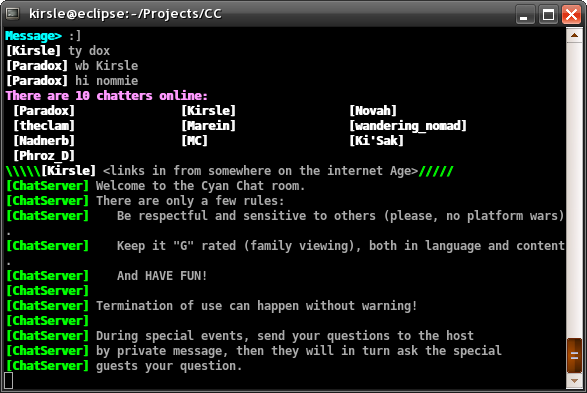
The script is mostly standalone: just one Perl script that uses Net::CyanChat. And also Term::ReadKey, which is easy to install. It doesn't use Curses or any other terminal GUI toolkit: it's all plain old text and ANSI colors. I built in my own kind of buffer system, and any time the chat dialog (or typed message prompt) changes, the window is cleared and redrawn from top to bottom, keeping track of how many characters and lines are being written so that it cuts off the buffer directly at the bottom of your terminal. And it works no matter what your terminal's dimensions are.
More screenshots:
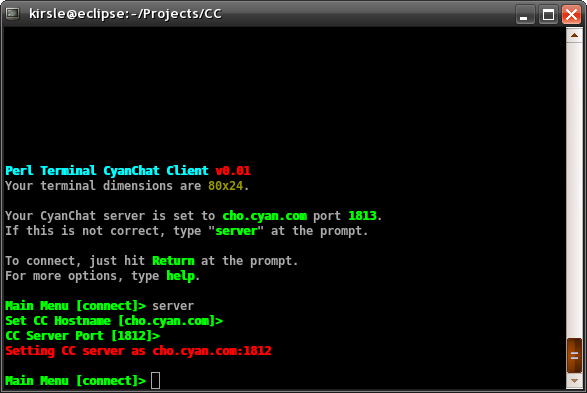
The main menu screen, changing the CC host back to using port 1812 (I used 1813 as the default port number for development purposes).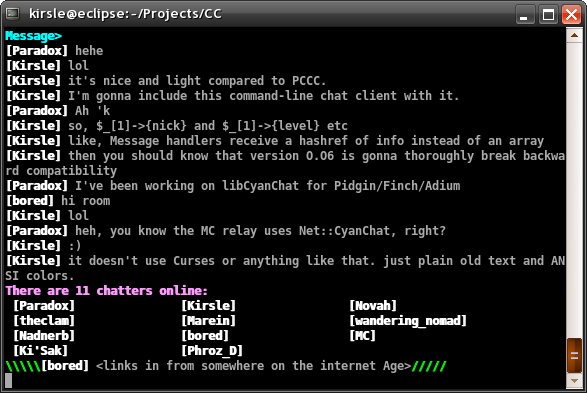
The CyanChat client in full operation.
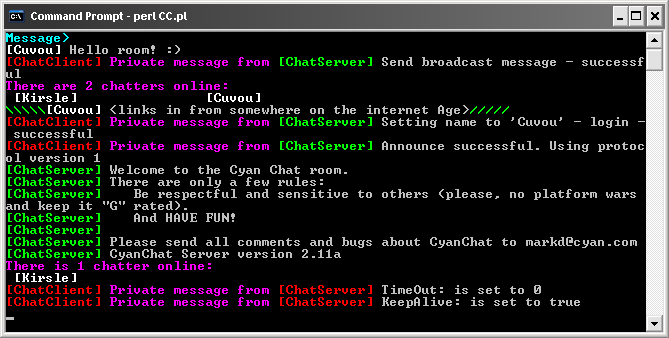
Update: It works on Windows too (to much amazement as the command prompt completely sucks):
Dynamic Drive's was cool and I've been using it thus far to generate all my favicon files (and some regular icons for use in some of my software like PCCC and ErrorGen), but my generator 1up's that by also being able to include 96x96 resolution icons (Windows Vista size).
To those curious, I mainly used the Perl modules GD and Imager to manipulate the uploaded image and save it as a Win32 icon. I won't give out the code behind my favicon.cgi though because it's really not that hard to figure out just from the manpages of the Imager module (see Imager::File::ICO).
sayto is a wall-like program I wrote at work which acts like wall but only broadcasts the message to a single user (instead of to every user), and takes care not to broadcast to any terminals that are running VIM, or any other process besides plain old bash (or other shells).
kbackupd is a backup daemon script I wrote for my web server. Others might find it useful so I've provided it for download.
Check them out on the Terminal Utilities page.
Here's a screenshot:
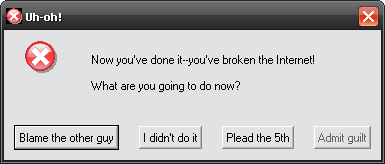
It's only a module so far that can be included in other Perl/Tk applications. But it's one very large step closer to me creating a simplified tool to spawn error boxes which could be provoked from batch files or scripts. It will probably have a syntax similar to the GNOME program, Zenity.
CPAN takes a few hours to index module updates but the new module will be available at Tk::StyleDialog on CPAN.org.
UPDATE: I've thrown together a quick program called ZenMsg (a name derived from GNOME's Zenity, but since my program only does dialog boxes, it's called ZenMsg).
I've added it as a new tab to the ErrorGen page. Let me know if it can be improved. I had to use ActiveState PerlApp to compile it because PAR::Packer (which I usually prefer to use) was giving me trouble and I didn't have the time or motivation to setup a clean new compiling environment for it. PerlApp may be a bit too limiting.
It turned out I was calling a blur() method on a variable that wasn't actually there, so on Windows IE it defaulted to the browser window. The intention was to remove focus on the hyperlink so that the dotted border wouldn't remain when clicking the tab.
Also, a small tweak in the style sheet means that the tab borders don't intersect through the top of the selected page.
The RiveScript.com YaBB forum has gotten at least two of these low-hanging spam bots recently. I modified the YaBB source to try and stop these things from being able to register by employing some of the same techniques that keep Cuvou.com safe from "dumb submitter bots" and we'll see if that helps...
Remind me to write a big long article about spam bots and how to fight them. I have some pretty good techniques that seem to work quite effectively but I currently don't have the motivation to write about them at this point in time.
Update: I've written an article about stopping dumb submitter bots: Trapping "Dumb Submitter Bots".
0.0033s.